Reps coached; 15+ now Heads of Sales at SaaS/AI companies
Investment in line with 1–2 months of a full-time VP Sales hire — a fraction of the risk.Apply →
Closed deals with
Clients
Who This Is For
You have leads. You don't have predictable revenue.
The pipeline exists — but conversion is inconsistent, sales is still founder-led, and the next obvious move feels like a $400K gamble on a VP hire with a 70% failure rate.
The situation
You're a Seed or Series A founder — Indian or European SaaS/AI, targeting the US market. The product works. Early customers exist. But revenue isn't compounding, the process lives in your head, and scaling it feels impossible without the right person in the room.
The gap
You don't need someone to tell you what good looks like. You need someone embedded in your deals, your calls, your pipeline — building the repeatable machine while your team learns it in real time. That's what I do, and I only work with 3 companies at a time.
"The problem isn't usually the person. It's the sequence — hiring for where you want to be, not where you actually are. Studies put the failure rate of first VP of Sales hires at early-stage startups at ~70%. That's the gap a Fractional CRO fills."
Why I Do This
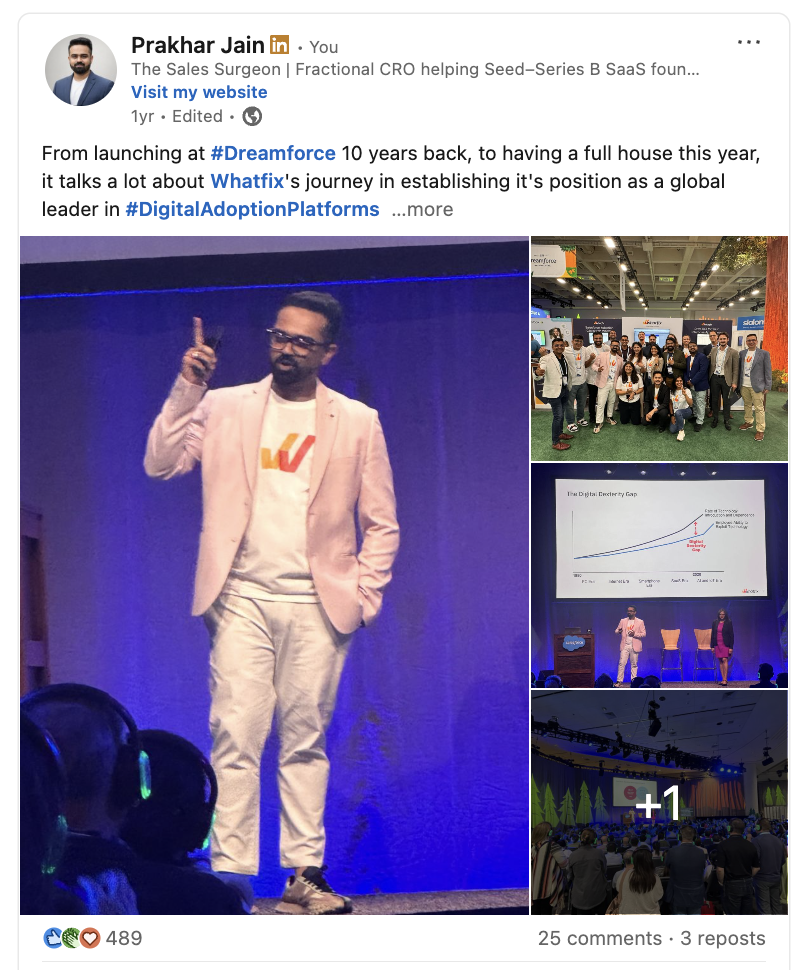
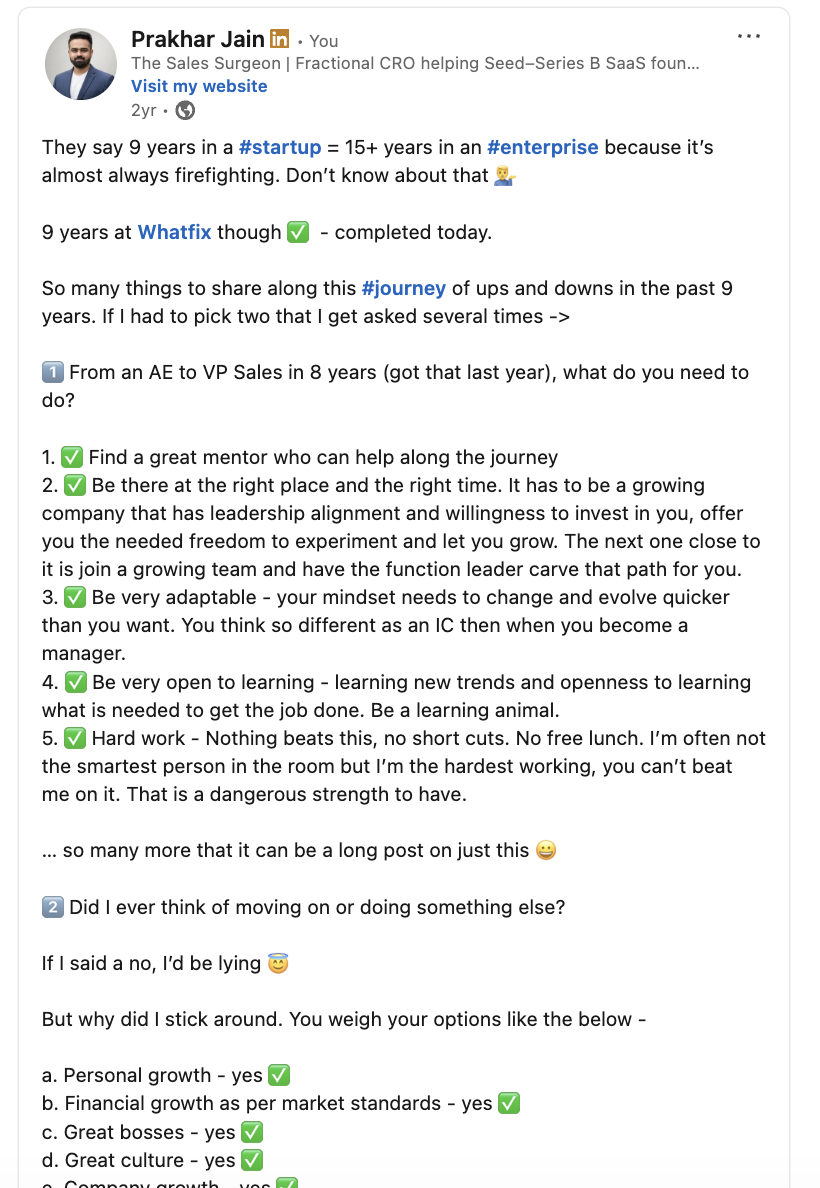
12 years. $0 to $100M. Then I left at the peak.
The India-US execution gap is real. I spent 12 years closing it at Whatfix — then decided to give that knowledge directly to founders.
2014
Employee #1
First salesperson at Whatfix. Started from zero.
2015
First Revenue
$0 → $1M ARR
First deals closed. Proof the product could sell.
2019
The Playbook
$10M → $50M ARR
Built repeatable US enterprise motion. First 50+ F1000 accounts.
2020
Scale NA + EMEA
First $1M+ deal
Land and expand at scale. North America and EMEA both firing.
2026
Peak & Exit
~$100M ARR
135+ Fortune 1000 accounts. 72% of company revenue. Left at the top.
NOW
The Sales Surgeon
3 clients max
Embedded execution. Not advisory distance.
For 12 years at Whatfix, I built something most people never get to see through — a $0 to $100M ARR journey from the first enterprise deal to 135+ Fortune 1000 accounts. From a handful of reps to a global sales org spanning NA and EMEA.
"72% of the company's revenue ran through me. And then I'd solved it."
I was walking away from financial security most people spend a career chasing, at what was genuinely the peak of my professional life. My family questioned the decision. But I kept coming back to one thought:
"If not me, then who?"
The India-US SaaS motion is broken — not because founders aren't smart enough, but because the execution knowledge that makes it work is sitting inside a handful of people who built it from zero. Most of them aren't sharing it.
One measure of what that knowledge produces: 15+ reps I coached at Whatfix have gone on to become Heads of Sales at high-growth SaaS and AI companies. The playbook is proven. The people who ran it are now running sales orgs of their own.
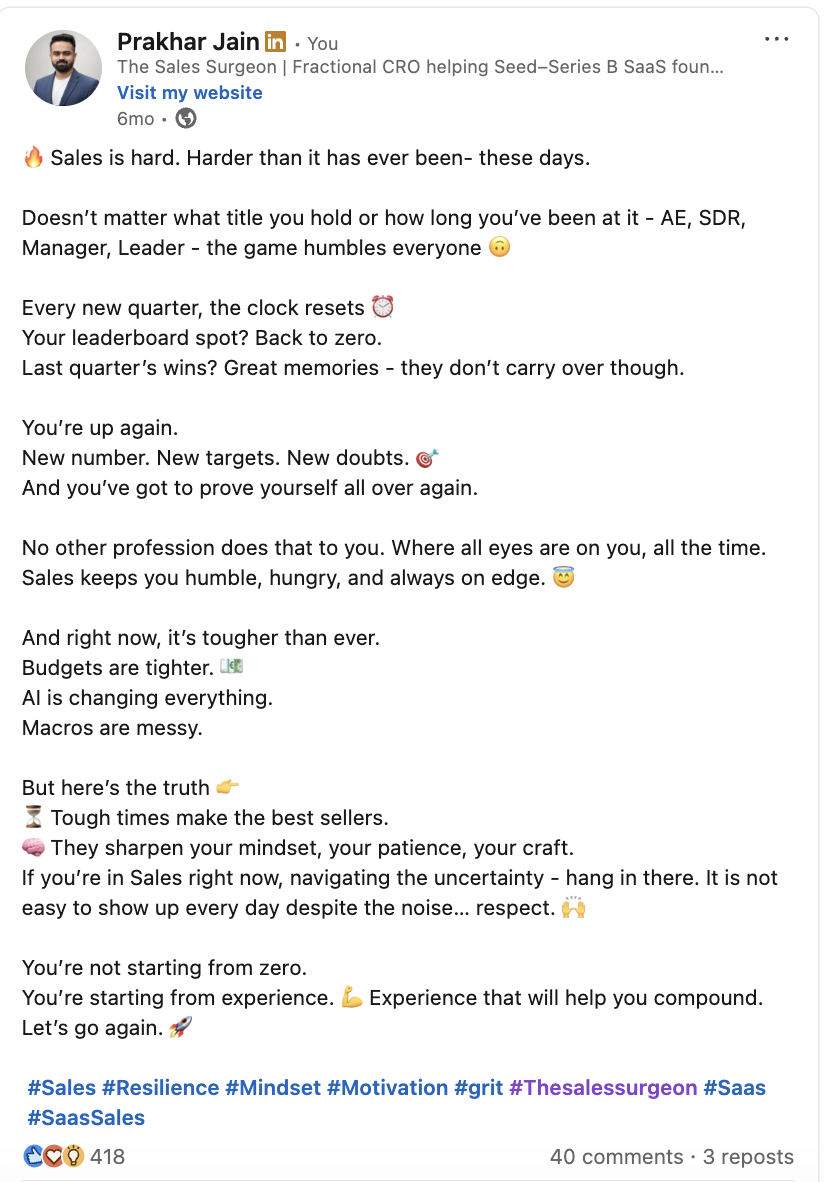
That's why I take only three clients at a time. That's why I get embedded instead of advisory. Under #TheSalesSurgeon, 23.3K followers — founders, revenue operators, GTM leaders — follow the work in real time.
"The India-US SaaS motion is broken. Most of them aren't sharing it. I am."
12
Years as Whatfix's Employee #1 — from first hire to Global VP
$100M
ARR scaled end-to-end at Whatfix
135+
Fortune 1000 accounts personally closed or led
300+
Reps coached — 15+ now Heads of Sales at SaaS/AI companies
The India-US SaaS motion is broken. Not because founders aren't smart enough — because the execution knowledge that makes it work is sitting inside a handful of operators who built it from zero. Most of them aren't sharing it. I am.
Prakhar's impact on Pintel's seed-stage growth has been immediate and measurable. By helping us refine everything from objection handling to early-hire profiles, he's effectively doubled our meeting output and accelerated our deal velocity by several weeks. He has the unique ability to zoom out for strategy and zoom in for execution. Working with 'The Sales Surgeon' isn't just about the 'Not-to-Do' list; it's about building a high-performance engine with someone who feels like a teammate in the trenches.
Vispi Daver
Angel Investor & CRO, Former Manager · Whatfix
Prakhar was the first person to join Whatfix after the founders and he has been instrumental in the growth of our Company. He led our Sales team as the company grew from his first joining to almost 900 people and 100s of Customers including many Global Fortune 500. I highly recommend Prakhar and TheSalesSurgeon. If you are a Seed or Series A company — you don't want a Consultant to tell you what to do. You want a Hands On Seller/Sales Leader that will actually DO what is required and learn fast to adjust your Go To Market for success. Prakhar is the perfect combination of deep diving into metrics and the behavioral/qualitative aspects of selling.
Neha Bagaria
CEO · HerKey
I worked with Prakhar when HerKey was at its 10 to 100 journey and we were rapidly scaling our sales engine. He worked closely with our sales leaders to set scalable systems, processes, org structures and work models in place, the fruits of which we see even today. For any founder trying to build a sales motion from scratch, The Sales Surgeon is the first call any founder should make.
Anand Kumar
Co-Founder & CBO · Skillate
I was a first-time founder, 25, never done enterprise sales before. I had two large enterprise customers but lacked the basics — how to formalise sales incentives for AEs and BDRs, how to handle compliance when prospects compare you to the best companies in the world, who to hire. Prakhar was kind enough to spend time whenever needed, despite his schedule at Whatfix. Thanks a lot for shaping the early sales motion of the company and helping me personally in every front to lead a sales team I was not equipped for.
Sahil Gupta
Head of Business Development · Supervity (formerly Techforce.ai)
What stood out was Prakhar's ability to quickly diagnose gaps in our sales approach and translate that into clear, actionable changes the team could implement right away. Having scaled from the first sales hire to leading global business development at Whatfix, he brings a rare mix of hands-on execution and strategic clarity. The sessions helped sharpen our pipeline thinking, improve deal structuring, and instill a more disciplined sales mindset across the team. The Sales Surgeon is not just about advice — it's about driving real, measurable improvements in how teams sell. Talents like Prakhar are rare in the SaaS world, and the best part — he knows the journey from $1 to $100M.
Fit Check
This Isn't For Everyone
If you're looking for someone to send you a framework deck and join a 90-minute Zoom every two weeks, there are plenty of those options. This is a different kind of engagement — and it's deliberately not for everyone.
Founders with no customers yet — there's nothing to systematize
Founders who want to hand off sales and disappear
Consumer, B2C, or hyperlocal businesses not targeting US B2B SMB or enterprise
Founders who want validation, not challenge
Founders not willing to be in the work alongside
Companies with no sales budget beyond the retainer
Businesses where the product is still changing every 30 days
Why execution-first beats advisory-only — every time.
The early-stage SaaS market is full of advisors who've built frameworks from pattern-matching across dozens of companies. What founders actually need is someone who has been in the trenches — and will get back in with them.
Dimension
Traditional Consultant The deck and disappear model
The Sales Surgeon The get-your-hands-dirty model
Primary output
Recommendations deck
Pipeline, playbooks, revenue
Involvement
Monthly advisory calls
Embedded — weekly + async
Who does the work
Junior team, supervised
Prakhar Jain, end to end
Ramp time
3–6 months to produce value
Value in the first 2 weeks
Market depth
Generic frameworks
15+ yrs of lived India→US execution
Companies at a time
15–20+ clients
Max 3 — by design
Accountability
Deliverables
Revenue outcomes
"I'm not a fractional CRO who sits in on your Monday all-hands and sends you a framework by Friday. I'm embedded in your deals, your calls, your pipeline — building the machine that outlasts my engagement."
Three Unfair Advantages
Built it from $0, not inherited it at scale — I know every stage of the growth curve you're on.
Proved India-to-North America enterprise sales at scale — this is not a theory for me.
3 clients — you get a real partner, not a time-sliced resource.
Want the full breakdown as a PDF?
The complete side-by-side — share it with your co-founder or board.
Love from the Whatfix Team
12 years. The team that built it says it best.
The standards you established and the playbooks you shaped will continue to influence how we sell, lead, and grow. You built strong teams, set a high bar for leadership, and consistently enabled people to succeed.
Romita Mukherjee
Head of HR · Whatfix
What I've admired most is the way you solve problems — calm under pressure, methodical, and always outcome-focused. You have a rare ability to simplify complexity and bring direction when things feel ambiguous.
Jack Anderson
Enterprise Sales Director · Whatfix
Your problem-solving mindset, calm in chaos, and willingness to be on the ground fighting alongside sellers every single day guarantees that wherever you go, something special will be built.
Pretyush Sharma
Enterprise Sales Director · Whatfix
A seller at heart, a leader by example. Your belief, coaching, and constant support shaped not just my career but my confidence. You gave me opportunities I wasn't sure I deserved, and bet on me again and again.
Krati Seth
Head of Global Revenue Enablement · Sales Enablement Leader of the Year 2025
~7 long years of working together. What I'll always value most is the way you approached everything as a true partnership — with trust, support, and a genuine "we'll figure this out together" mindset.
Arijit Bhattacharjee
Regional Head of Talent Acquisition · Whatfix
If you're lucky enough to work for Prakhar, you won't just become better at your job. You'll become a better professional, and quite possibly, a better human.
Abhinav Kumar Gupta
Chief of Staff → Sales Manager · Whatfix
Wall of Love
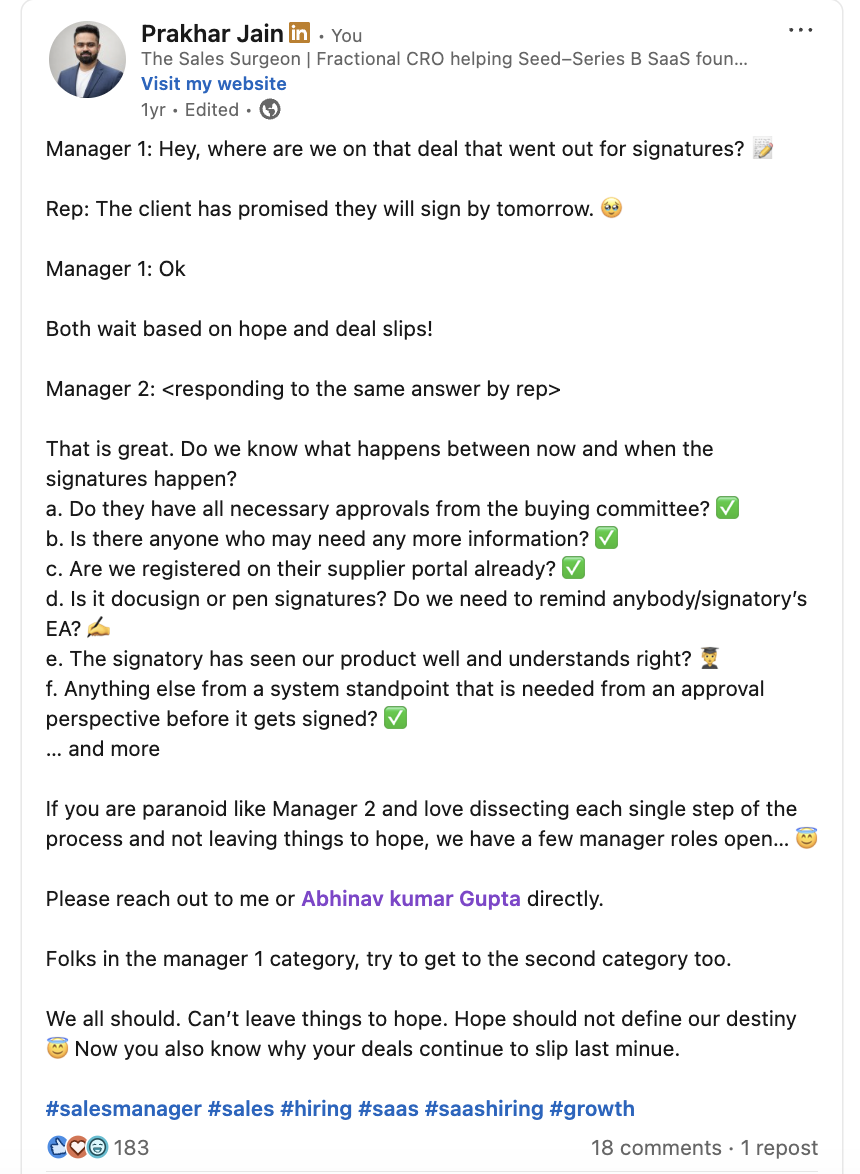
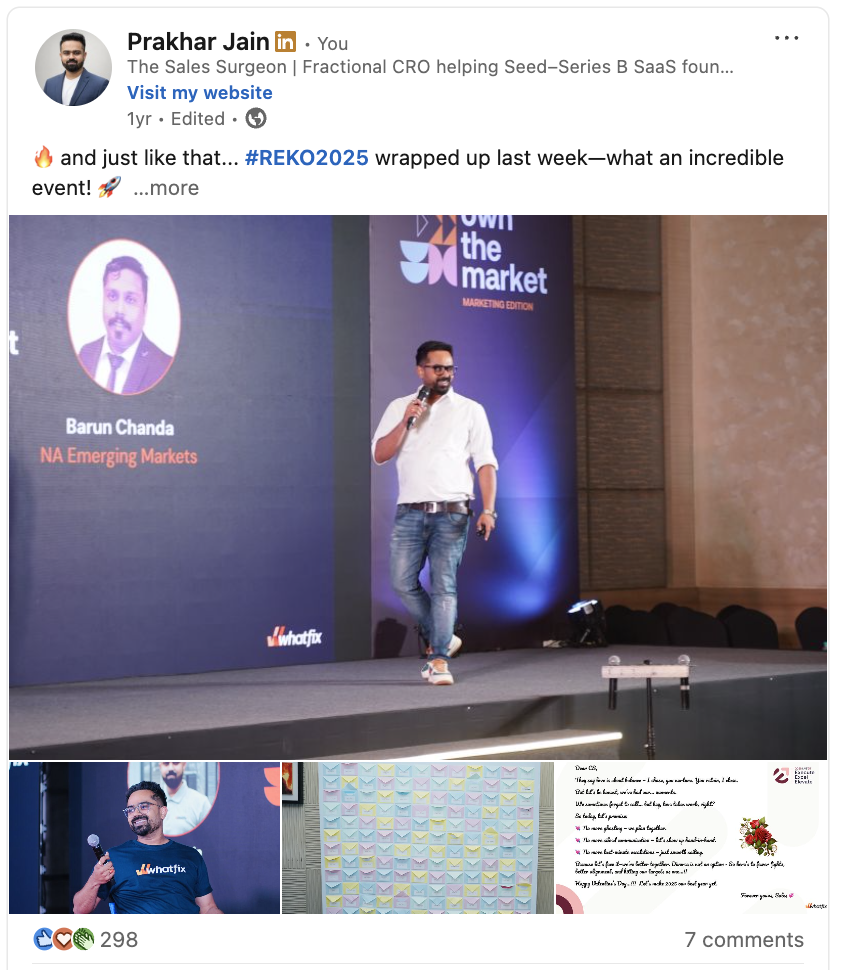
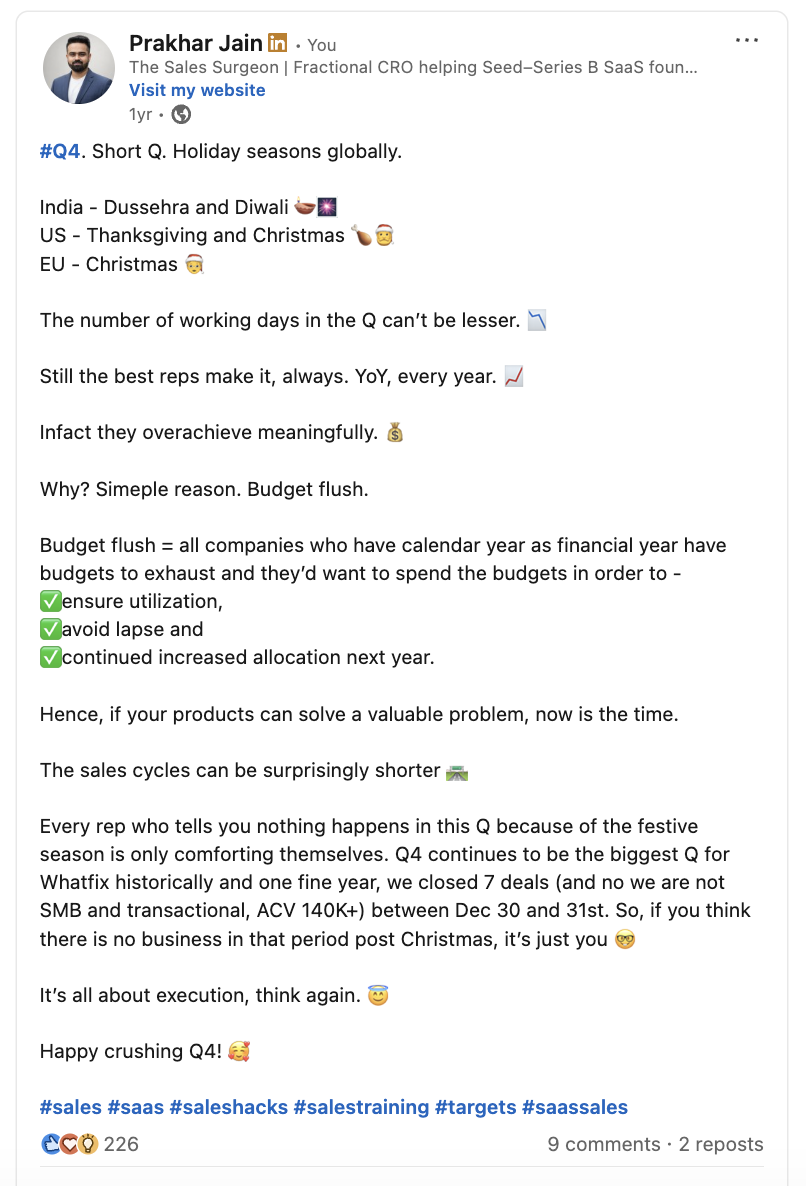
23,300 people follow the work in real time.
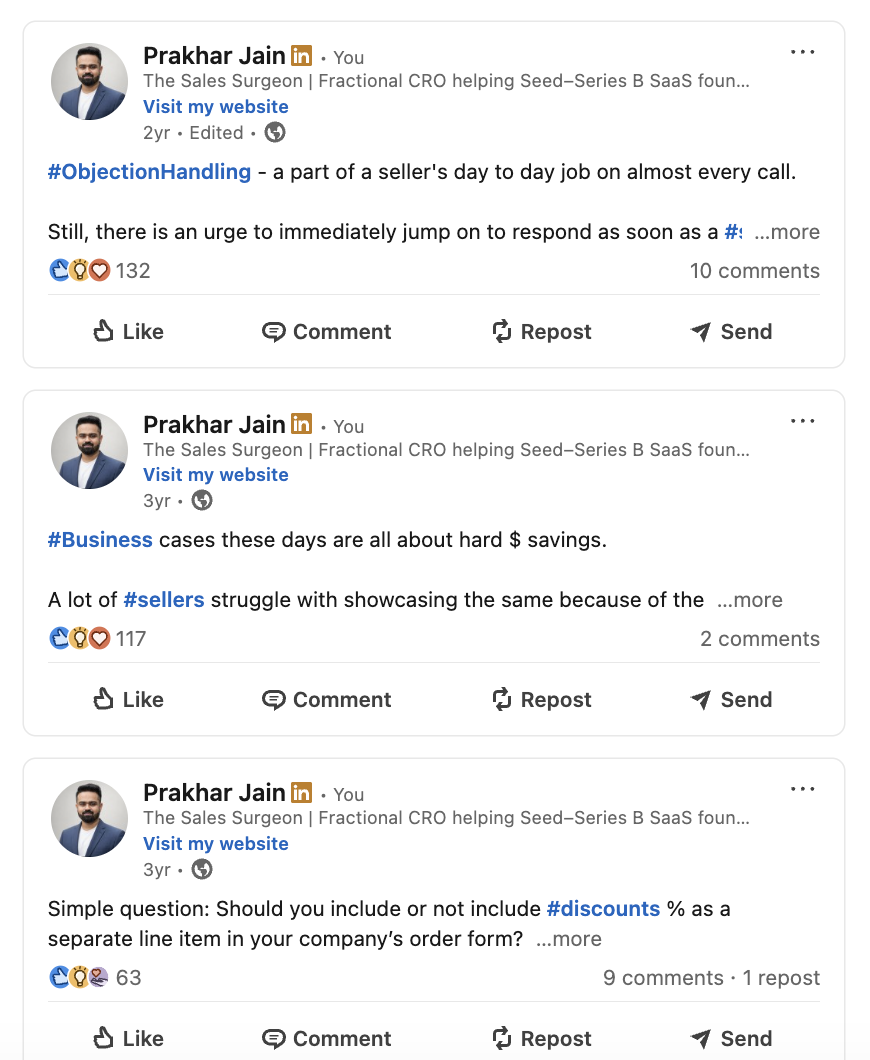
Posts that land with revenue operators, founders, and GTM leaders every week. None of this is polished content — it's pattern recognition from the field.
Three engagements. Three distinct moments. Pick the one that matches where you are — not where you want to be.
01
Revenue Sprint
Build the full revenue machine — embedded, start to finish.
12 weeks, embedded. In your pipeline, calls, CRM, and team rhythm — building the repeatable motion in real time. You're getting output from Day 1, not month 3.
3–4 structured sessions, 60 min each. I come in as a challenger — not a validator. For when you need to know what you're missing before making an expensive decision.
ICP Pressure-testGTM Gut-checkHiring ReviewFundraise vs. GTM Reality
Light on hours, high on impact. Async access when it matters — for deal gut-checks, hiring calls, GTM direction, and the hard question you don't want to ask your board.
Async AccessDeal Gut-checksHiring DecisionsBoard PrepGTM Direction
Revenue Sprint and Compass are retainer engagements — max 3 active retainer clients at a time, by design. The Second Opinion is a standalone engagement with no ongoing commitment. All engagements start with a conversation — if it's not the right fit, I'll say so before anything changes hands.
What Gets Built
Four pillars. One outcome: a revenue machine you own.
Every Revenue Sprint covers all four — sequenced to your stage, gaps, and the highest-leverage problem first. The diagnosis runs in parallel with the build. You're getting output from Day 1.
01
ICP, Positioning & Revenue Architecture
Stop selling to everyone. We define exactly who you should be winning, why they buy, and what your revenue motion looks like at $1M ARR and beyond — grounded in where you actually are, not where you hope to be.
ICPPositioningPipeline DesignRevenue Planning
02
An Outbound Engine That Runs Without You
Calls and emails are two channels. A real outbound motion runs across 7–8: LinkedIn, investor network, founder network, partners, communities, events, warm referrals, and more. We build the full air cover — not just sequences — with meeting-booked rate as the leading indicator we move first.
Discovery that uncovers real pain instead of pitching features. Demo structure that builds urgency. Objection handling that's documented and trainable — not locked in one person's head. The proof: 15+ reps I've coached have gone on to become Heads of Sales at SaaS/AI companies.
The playbook doesn't expire when the 12 weeks end. Every framework, scorecard, and sequence is yours — to run, train on, and hand to your next hire. Win/loss analysis, metrics dashboard, and a hiring brief built for where you actually are.
ForecastingConversionGTM AlignmentHiring Playbook
The Engagement
12-Week Revenue Build Sprint.
A focused sprint, not an open-ended retainer. You get a dedicated partner — not a deck and a goodbye.
Discovery
Wk 1–2
ICP definition
Gap assessment
Competitive read
GTM Foundation
Wk 3–4
Playbook v1
CRM setup
Outbound architecture
Outbound Launch
Wk 5–6
First cadences live
Scripts refined
Pipeline review cadence
Pipeline
Wk 7–8
Demo coaching
Follow-up templates
Sales–mktg alignment
Closing
Wk 9–10
Negotiation playbook
Metrics dashboard
Win/loss analysis
Handoff
Wk 11–12
Hire recommendation
Onboarding plan
Full playbook handoff
How We Work Together
Structured sprints. Real access. Full focus.
No open-ended retainers. No junior teams. No 20-client dilution.
⏱
8 Hours / Week
Structured weekly sprints with clear deliverables — split roughly between building (frameworks, playbooks, sequences) and coaching (pipeline reviews, rep sessions, deal strategy). Every week has a focus area you can see and measure.
💬
Async Access
WhatsApp or Slack for quick questions, live deal reviews, and real-time team support when it matters most.
🎯
Cohort of 3
Maximum 3 companies at a time — by design. You get a real partner, not a time-sliced resource across 20 clients.
The Guarantee
Most consultants ask for trust upfront. I earn it in four weeks.
This is a real commitment of time, attention, and resources — and it should come with a real promise.
Here's mine:
By End of Week 2
A written diagnosis of your top 3 revenue blockers
Specific, prioritised, and actionable — not a vague overview. You'll know exactly what's blocking growth and in what order to address it.
By End of Week 3
A 12-week sprint plan built around your team
Built around your team, your pipeline, and your stage — not a template pulled from the last client. This is the actual plan we execute together.
By End of Week 4
Your first fix in motion
Whether that's your outbound sequence, your qualification framework, or your conversion layer — something concrete is already moving by the end of month one.
If any of that isn't delivered, you can exit cleanly at the end of Month 1 — no obligations for M2 and M3, no awkward conversations.
I've structured it this way because I'm confident in the work — and because a founder committing at this level deserves to see proof before they're fully in.
The question is never whether this is a lot. The question is what it costs compared to the alternative.
Full VP of Sales Hire
India VPS base salary~$100K / yr
Recruiter fee~$8,500
Ramp period (zero output)3–6 months
Failure rate at Seed/A~70%
If it fails: restart cost$55–80K
US VPS (OTE + recruiter + ramp)$400–500K mistake
The Sales Surgeon
Engagement structure12-week sprint
Investment~1–2 months of a VP's salary
Ramp periodValue in week 1
Failure riskExit at Month 1, no obligation
Equity givenZero
What you own at the endFull GTM playbook
What Founders Actually Burn Without This
The wrong tradeshow$35,000 + three weeks. Zero pipeline.
Sponsorship, logistics, travel, prep time. $35K and three weeks later you have 50 business cards and a follow-up sequence nobody replies to — because the ICP was wrong before you booked the booth.
The SDR hired before the process existed$15–20K in ramp waste. Zero pipeline.
No playbook, no ICP clarity, no sequences. Three months of salary before a single qualified meeting is booked.
The wrong ad campaign$25–30K. Pipeline: zero.
Wrong ICP, wrong channel, wrong message. The spend is real. The pipeline isn't.
The discount that became the default$15–20K left on the table. Per deal.
No value framework, so the AE drops 30–40% to close. At $50K ACV that's $15–20K per deal — multiplied across a year.
One of these mistakes costs more than the entire engagement. Most founders make three or four before they realise what is happening.
Outcome Based Execution
This is not a consulting fee. It is an asset purchase. By the end of twelve weeks your company owns:
6
assets you own
✓ Delivered
Written ICP Definition
Sales, marketing, product stop arguing in month 1
Precise firmographic, behavioural, and trigger criteria your entire team aligns around — documented.
✓ Delivered
Outbound Playbook
Qualified meetings: X → 2X within the first sprint
Sequences, messaging, targeting, cadence — built and tested. SDRs run without you in the room.
Your AEs know within 2 calls which deals are worth chasing — and which ones to walk away from.
✓ Delivered
POC Framework
POC-to-close improves — deals stop dying at the finish line
Success criteria, champion mapping, commercial guardrails — the last 10% can't undo the first 90%.
✓ Delivered
Hiring Framework
Right hire, right stage — not a $200K experiment
AE, SDR, or Head of Sales — a scorecard and brief built around where you actually are, not where you're going.
✓ Delivered
Campaign Clarity
20–30% wasted spend cut within 30 days
Which channels deserve budget, and where you're currently burning money on the wrong ICP.
At $50,000 ACV, moving your win rate by five percentage points across twenty demos a quarter is $50,000 in additional revenue. The engagement pays multi folds of itself before week twelve.
The Number
Three months. A fixed monthly retainer.
One wrong tradeshow costs more. One mis-hired VP costs ten times more. One year of discounting because the value framework was never built costs more than you will ever put in a spreadsheet.
The question was never whether this is expensive. The question is whether you can afford to keep figuring it out without it.
Your background is Whatfix and Fortune 1000 enterprise. How relevant is that to a founder still building their US beachhead?+
More relevant than it looks. The logos are proof of destination, not description of the work. Most of what I do now — defining ICP, building outbound motion, fixing conversion, getting founders out of every deal — is the opposite of enterprise. Whatfix gave me the reps to know what works and what breaks at scale. What I bring to you is the pattern recognition to skip the expensive mistakes founders make between $1M and $10M ARR. I am a problem solver at heart and what I bring to the table is that knack of figuring experiments for you that are not just growth hacks, but can scale.
I already have a team — 3 AEs, 2 SDRs. Is this engagement for me, or is it more useful for pre-team founders?+
This is actually the ideal stage. Pre-team, there's nothing to build on. With a small team in place, the leverage is much higher — the gaps are usually not people, they're process, sequencing, and coaching. Most founders at your stage have hired people before defining what they should actually be doing. We fix that together. Your reps stay. Their output changes.
What does 6–8 hours per week look like in practice? Is it calls with me, or are you actually in the work?+
Both — and the ratio shifts by sprint phase. In the first two weeks it's heavy on diagnosis: I'm in your pipeline, listening to calls, reviewing sequences, talking to your reps. By weeks four through eight it's active build — playbooks, qualification frameworks, outbound structure. The back end is coaching and reinforcement. I don't send you decks. I'm in your Slack, in your deals, in your team reviews. The 6–8 hours is a floor, not a ceiling.
Do you work directly with my reps, or does everything go through me as the founder?+
Directly with the team — with your context and buy-in. Founders can be a bottleneck by nature. If every coaching moment has to route through you, the change doesn't stick. I'll align with you on direction and priorities, but I'll work with your AEs and SDRs in real sessions. You'll know what's happening and why. You won't need to be the messenger. And that gives you some weekly hours back.
I'm evaluating a Head of Sales hire at the same time. Does bringing you in conflict with that, or should these run in parallel?+
They can run in parallel — and the sequencing actually matters here. The number one reason early-stage VP of Sales hires fail is that the founder hasn't defined what success looks like before the hire. We spend the first 12 weeks building exactly that foundation: the playbook, the ICP clarity, the pipeline benchmarks. When a great Head of Sales walks in on week 13, they have something to lead, not a blank slate to build alone. I've helped several founders make better hiring decisions specifically because we did this work first.
What does Week 1 look like? How quickly are you actually in the work?+
Fast. There's no month-long discovery phase. Week one is pipeline audit, call review, and a working session with you to align on the single biggest revenue blocker. By the end of week two you'll have a prioritised diagnosis and we'll have started work on the first fix — whether that's outbound sequencing, qualification, or positioning. The 12 weeks are structured but the first sprint starts immediately.
What happens at week 12 — do we renew, do you hand off a playbook, or does the engagement just stop?+
Week 12 ends with a documented playbook your team owns, measurable benchmarks set, and a clear picture of what comes next. Some founders renew for a second sprint at a different focus area. Some bring on a Head of Sales and I do a 30-day handoff. Some are ready to run independently. The goal is never dependency — it's that by week 12 you should have enough to run a repeatable motion.
There's no pricing on the site. What does this actually cost?+
Engagements are structured as a 12-week sprint. Investment is in line with 1–2 months of a full-time sales hire — a fraction of the risk. Exact pricing is shared after the diagnostic call, because the scope varies — a founder with 2 SDRs and no playbook needs different work than one with a full team and a broken conversion rate. What I can tell you: it's structured to be measurably cheaper than a mis-hire and faster than a 6-month external hire process. If the diagnostic reveals I'm not the right fit, I'll tell you directly before any money changes hands.
I'm not choosing between you and a VP of Sales — I'm considering both. How does this change that decision?+
Hiring a VP of Sales without a defined playbook is one of the most expensive mistakes I see at Series A. 70% of early-stage VP hires fail within 18 months — mostly because the founder handed them an undefined problem and a small team. Sometimes, you don't even have enough work that would keep a VP Sales busy. What I do in 12 weeks is build what a VP of Sales would spend their first six months building — except we do it together, faster, and without the equity or $250K OTE. You end up with a stronger foundation and a better brief for the hire. Both can coexist. The sequence just matters.
What does success actually look like at the end of 12 weeks? What's measurable?+
We agree on this at the start based on a diagnosis questionnaire, not the end. Before week one, we align on two or three leading indicators specific to your situation — could be outbound reply rate, demo-to-close conversion, pipeline coverage ratio, average deal velocity, hiring framework, etc. The sprint is structured around moving those numbers. I don't define success vaguely so it can't be held against me — that's exactly what advisors do. The whole model only works if there's something concrete we're aiming at.
What if things aren't clicking by week 6? Is there a course correction, or do we just run out the clock?+
There's a structured midpoint review at week six. We look at what's moved, what hasn't, and whether the original diagnosis was right. If the problem shifted or something new surfaced, we adjust the back half of the sprint. If I got something wrong in the early assessment, that's on me to fix — not yours to absorb. The 12 weeks is a commitment from both sides, which is exactly why I cap at three clients. I can't do mid-sprint corrections at scale.
What's my commitment going in? Is there an exit if things don't work out?+
The engagement is a 12-week sprint, but the commitment is earned, not assumed. At the end of week four we do a formal checkpoint — you've seen how I work, what the diagnosis surfaced, and what the next eight weeks are built around. If it doesn't feel right for any reason, you can exit cleanly with no further financial obligation for M2 and M3. No awkward conversations, no lock-in. I'd rather you leave at four weeks than stay twelve weeks unconvinced. Beyond that point, I ask for full commitment — because the work in weeks five through twelve is where the real build happens, and half-engagement on either side doesn't serve anyone.
You only take 3 clients per quarter. How do I know I'm actually getting the hours and focus you're promising?+
The cap exists precisely because of this question. At four or five clients, the math breaks. You'd get an advisor, not an embedded partner. Three clients is the number where I can be genuinely in your business — in your pipeline, in your team's weekly rhythm, available when a deal needs real input. If I'm at capacity when you reach out, I'll tell you honestly and we can plan for the next sprint start rather than take you on under-resourced.
You mention async Slack and WhatsApp. If a deal is closing on a Friday and I need a live call, are you actually available?+
Yes. The async model is for the routine — updates, quick feedback on sequences, reviewing a proposal draft. It's not a buffer for when things matter. A closing deal is exactly the situation where I expect to be called, and I'll pick up and guide the best. Joining client calls is not part of the standard engagement, but it's not off the table either. If a deal needs it and we both agree it's the right move, it happens. What I won't do is become your closer — because that doesn't scale past me, and scaling past me is the whole point.
Apply for a Diagnostic
Is this the right fit? Let's find out.
Takes 2 minutes. I review every application personally and reply within 48 hours — with an honest take on whether this makes sense for your stage.
"All three spots for this quarter are engaged. I'm in early conversations for next quarter now — if you're thinking about it, reach out before the window closes."
Step 1 of 7
What's your name?
First name is fine.
Your work email?
I'll use this to follow up.
Company name and website?
One line is fine.
What stage are you at?
Pick the closest one.
What's your current ARR?
Approximate is fine.
What's your biggest GTM challenge?
Pick the one that keeps you up at night.
Anything I should know before we talk?
Optional — more context = better diagnostic.
✓
Application received.
Prakhar will review this personally and be in touch within 48 hours.
Ready?
Currently at capacity. Next Sprint, open now.
Consultants give you a map. I drive with you.
Investment
Engagements are structured as a 12-week sprint. Investment is in line with 1–2 months of a full-time sales hire — a fraction of the risk.